READING IN DECEMBER: Intimate Death;

INTIMATE DEATH: HOW THE DYING TEACH US TO LIVE by Marie de Hennezel.

This book is also known as 'Seize the Day' depending on the publisher.

 I work closely with terminally ill patients, helping them compile biographies of their lives to leave their families. And yet this process is as much about the patient as it is about the legacy being left. Is there anything more cathartic and indulgent than telling a complete stranger stories about your life, and then seeing it in writing and adorned with photos? For the patient it gives dignity and honour at a difficult time. For me, and I imagine other biographers, it is perhaps one of the most humbling and humane things that can be done for another person. And brings home to me, so much younger than most of the patients I deal with, the title of this book - how the dying teach us to live. Death is a subject that in our Western civilisation bubble, we choose not to think about until we are suddenly confronted with it. In the flood of emotions that corkscrew through us, we find death is something we are really quite ill equipped to deal with. This beautifully written, and at times achingly sad book lifts the lid on, quite simply, what it is like to die. The author is a psychologist/psychotherapist who specialises in caring for palliative care patients. She works mainly in hospice settings in France. This book has been translated from French. This woman has compassion in buckets, and it seems to me walks a very fine line between her professional role in caring for the patient, and her instincts as a human being to nurture and love those she is caring for. She takes a number of patients of various ages suffering from various illnesses - cancer, aids, motor neurone - and shows us that one's last journey need not be as sad, awful, and heartbreaking as we think it is. By giving these patients dignity, talking to them, letting them talk, not wallowing in sadness when with them, the whole business takes on new and uplifting meaning. The most important things I got out of this book? The importance of a smile, the importance of the touch of hand on hand, and what it really means to be human.

NOVEMBER READING : WAITING FOR SUNRISE


WAITING FOR SUNRISE by William Boyd

In our book club we love William Boyd. His books are always satisfying, complicated, great plots, interesting flawed protagonists, or as one reviewer puts it - there is always a 'Dude with a Problem'. And the author himself is timeless, judging by the photo that graces the book covers. Although as an aside, the photo on the cover of this, his latest, does actually resemble a man who could be approaching 60 years of age!

Lysander Rief is a young Englishman, an actor, who is the son of a now deceased famous actor father. He is engaged to a young actress. He comes to Vienna in 1913 to seek a cure for a personal and private problem, Vienna of course being the home to Sigmund Freud and his theories of psychoanalysis. Lysander is very much an innocent abroad, rather dull, indecisive, bit of a wimp really. In Vienna he meets a wide assortment of very interesting people ranging from his fellow lodgers, his therapist, a fellow patient with whom he has a very complicated entanglement, and some fellow Brits. Life suddenly takes a very dark turn for Lysander, and it seems as if he goes through a personality transplant in the process. The result is a man of action who would not be out of place in a John Le Carre novel. Suddenly his life has a purpose, ie save it, and in the process uncover a mole deep inside the British military machine.

Because of course, by now it is World War I. Lysander is quite literally, thrown in the deep end, on his quest to solve the intelligence leak. This takes him to the trenches, to Switzerland, back to England, tripping around all over the south coast, dealing again with his complicated entanglement, finding true love, and finally managing to derail the traitor. Quite an achievement really for someone whose life only months before appeared to be going nowhere.

I know it is all only fiction and made up, but the changes that take place in Lysander I did find a little far fetched. Maybe his psychotherapy treatment produced a truly new man! Maybe those acting genes finally kick in. The book could be psycho analysed forever in an attempt to understand the author's purpose. But it doesn't really matter because this is a very readable, action filled, page turner of a book. The story may be a little uneven, the ending a bit of an anti climax, but William Boyd's writing, as usual, is flawless. It doesn't take much for him to pick the reader up and throw them into the action too.

READING IN NOVEMBER - Waiting for Sunrise; Bitter Almonds; We Are All Made of Glue; The Blasphemer


WAITING FOR SUNRISE by William Boyd

In our book club we love William Boyd. His books are always satisfying, complicated, great plots, interesting flawed protagonists, or as one reviewer puts it - there is always a 'Dude with a Problem'. And the author himself is timeless, judging by the photo that graces the book covers. Although as an aside, the photo on the cover of this, his latest, does actually resemble a man who could be approaching 60 years of age!

Lysander Rief is a young Englishman, an actor, who is the son of a now deceased famous actor father. He is engaged to a young actress. He comes to Vienna in 1913 to seek a cure for a personal and private problem, Vienna of course being the home to Sigmund Freud and his theories of psychoanalysis. Lysander is very much an innocent abroad, rather dull, indecisive, bit of a wimp really. In Vienna he meets a wide assortment of very interesting people ranging from his fellow lodgers, his therapist, a fellow patient with whom he has a very complicated entanglement, and some fellow Brits. Life suddenly takes a very dark turn for Lysander, and it seems as if he goes through a personality transplant in the process. The result is a man of action who would not be out of place in a John Le Carre novel. Suddenly his life has a purpose, ie save it, and in the process uncover a mole deep inside the British military machine.

Because of course, by now it is World War I. Lysander is quite literally, thrown in the deep end, on his quest to solve the intelligence leak. This takes him to the trenches, to Switzerland, back to England, tripping around all over the south coast, dealing again with his complicated entanglement, finding true love, and finally managing to derail the traitor. Quite an achievement really for someone whose life only months before appeared to be going nowhere.

I know it is all only fiction and made up, but the changes that take place in Lysander I did find a little far fetched. Maybe his psychotherapy treatment produced a truly new man! Maybe those acting genes finally kick in. The book could be psycho analysed forever in an attempt to understand the author's purpose. But it doesn't really matter because this is a very readable, action filled, page turner of a book. The story may be a little uneven, the ending a bit of an anti climax, but William Boyd's writing, as usual, is flawless. It doesn't take much for him to pick the reader up and throw them into the action too.


BITTER ALMONDS by Mary Taylor Simeti and Maria Grammatico

I have mixed feelings about this book. Firstly what sort of book is it? Is it a recipe book - 111 pages of its 229 pages are recipes; secondly is it biography of Maria Grammatico or thirdly is it a memoir of Mary Taylor Simeti telling how she came to be telling Maria's story. And these two latter stories cover the first 118 pages.

There is a terrific story here in the life Maria Grammatico.  In the 1950s, her impoverished mother sent her, at the age of 11, and her older sister to live in the enclosed and cloistered world of the local convent. There were approximately 22 people living in the convent of whom 13 were nuns, the rest young girls such as Maria and her sister. Maria lived here till the age of 25, when she left the convent. The only skills she had were how to make the delicious, dainty, delectable pastries, sweetmeats and biscuits that she had 'acquired' over the years living with the nuns. The nuns produced vast quantities of these morsels to sell to the locals on feast days and religious celebrations/ceremonies. None for the girls.  It was an appalling existence really for young girls. There was never enough food, very few comforts, very little if any freedom, no celebrations or fun of any kind. The one solace for Maria was the kitchen. Now, in her fifties, she still lives in the town the convent was in - Erice - and has her own very famous and highly regarded Italian patisserie where she makes, by hand, all the delicacies she had learnt all those years ago. On You Tube there are some lovely films of Maria in her kitchen and interviews with her about her life. I would love to have had the whole 229 pages about her life, more about what convent life was like, more about what happened to her when she left the convent, how she started her business  - I kid you not, it is summarised in one paragraph. Very very disappointing.

So is the book then a memoir of the writer, Mary Taylor Simeti and how she came to meet Maria and write the book. Unfortunately there is almost as much about this as there is about Maria. Mary is a successful writer herself, married to a Sicilian and living on Sicily. Her books about Sicilian food and travel are highly regarded and would appear to be well worth reading. But to me, this little book, should not be about her, and unfortunately it is. She intersperses Maria's story with snippets from her own, and the thread really does at times become quite confusing.

Then we come to the remaining 111 pages of recipes. And glorious they are too! From almond dough, almond cream, ricotta tart, citron jam, marzipan,  fig biscuits, preserves - 46 recipes in total. And all this is marvellous to read too! But is it perhaps just a little too much?

My overall feeling on finishing this book was that I felt cheated. And that Maria actually deserved more. Maybe one day someone will write a real biography of Maria's story instead of this offering.


WE ARE ALL MADE OF GLUE by Marina Lewycka I actually really liked this book, despite the many negative reviews that have been written about it. No, it is not nearly as good as her first novel 'A Short History of Tractors in Ukrainian' or even 'Two Caravans', but I found it hugely enjoyable with its convoluted slightly ridiculous plot, equally eccentric and stereotyped characters, and at times really quite funny. I enjoyed this novel far more than the author's latest 'Various Pets Dead and Alive' which I reviewed in September, even though it is all over the place and has more threads going on than an out of control sewing machine. Georgie Sinclair has recently separated from her husband Rip (ridiculous name). She has two children, the younger one Ben is still at school and lives with her. The daughter, Olivia is at university. Georgie has a rather strange job writing for a trade magazine that specialises in glues and adhesives. So all the chapters are headed with some sort of adhesive that may or may not be relevant to the contents of the chapter, for example Rubber, Biopolymer, The Attraction Between Adhesives and Adherends'. Very intriguing. Her husband walking out after an argument over the attachment of a toothbrush holder to the bathroom wall has left Georgie in a bit of a state. In the process of venting her rage by throwing all his precious LPs into a skip she meets an elderly, possibly eccentric lady who resides nearby called Mrs Shapiro. An unlikely friendship begins to unfold. Georgie suddenly finds herself named by Mrs Shapiro as her next of kin following an accident that requires the latter to stay in hospital for a spell, and then run the gauntlet of compulsory and permanent removal to a rest home. It becomes Georgie's 'job' to protect Mrs Shapiro's interests from the Social Welfare bureaucrats, the local real estate agents/sharks, feed the stray cat population, and try to find out more about Mrs Shapiro, her mysterious past and hopefully some relatives. At the same time Georgie is dealing with her Ben who is losing himself in the cyber universe convinced the world is going to end any day, Rip the husband, her closet romance writing (dreadful),and her own search for new love. This book highlights just perfectly how there is nowt as queer as folk, that we are all bound together in some way or other, and that out of any situation that may arise, with a little effort there is always a way forward. Yes it has it faults. For example I am still not really sure why the marriage reached such a crisis point, the overly simplistic view of the Palestinian/Israeli conflict, even the mysterious past of Mrs Shapiro. But despite all this it is a joy to read, and likely to leave a smile on your face at the end of many of the gluey chapters.
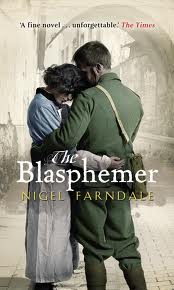
THE BLASPHEMER by Nigel Farndale

My goodness, there is SO much going on in this book, it's a minor miracle it is all packaged up and concluded in 492 pages. Is there a God or is there not? Was the earth created in seven days or not? Are there angels or not? And that is just for starters. But having said that, these three questions form the crux of the novel.

Daniel Kennedy is an atheist. He is also an associate professor of zoology at Trinity College in London, and has recently written and fronted a natural history television programme.  He lives in London with his long time girlfriend Nancy and their nine year old daughter Martha. When the book opens he and Nancy are preparing to take a trip to where the creation vs evolution debate began - the Galapagos Islands. On the way to their island destination, the sea plane crashes, Daniel makes an error of judgement, but does survive, as does Nancy, although his actions reverberate for months afterwards. Immediately post crash, as penance perhaps, Daniel makes the decision to swim the 14-odd kilometers to shore for help and during the swim has a vision of a young man - angel - who encourages him, enabling Daniel to hang on and eventually reach shore. All is well. Except for Nancy and Daniel's relationship which goes into freefall.

Running parallel to Daniel's story is that of his great grandfather, Private Andrew Kennedy, 21 years old, on his first day facing the horrors of Passchendaele. Andrew is a plumber, a very ordinary young man, brought up to believe in a God and that God is on the side of the right, which naturally includes him. His first day of war is a complete disaster, and he sees a vision which takes him off the battlefield, into a village in France, only to find himself some months later in front of a firing squad for desertion.

As if these two threads don't have plenty of potential for plot and character, the author also throws in radical Muslims and terrorist attacks,  a bitter and twisted university academic, nine year old Martha madly in love with her teacher, Mahler and Vaughan Williams, old age and mortality, distinguished military careers, other love interests, and long winded philosophical discussions on whether there are angels or are such visions a frontal lobe malfunction due to extreme stress. Quite frankly it all gets a bit much, with the whole story becoming quite incongruous and far too many coincidences for it to have any chance of being truly credible.

But despite the weakness with plot and lack of character development of some important people in the story, this does actually read very well and is quite a page turner. The author knows how to make a story. I did enjoy it, and who knows, maybe there really are angels out there.

READING FOR OCTOBER - The Good Doctor by Damon Galgut


 THE GOOD DOCTOR by Damon Galgut

You know there will be no happy ending when the opening line is 'The first time I saw him I thought, he won't last.' The first two pages are full of words like -  tall, thin, dusty, empty, frail, wilting, burden of leaves, ragged trees, basic standard issue, ugly, austere -  and the best one of all which sums up the whole mood of the book - bleak. What a writer this man is. From beginning to end the reader is taken on slowly unwinding spool of inevitable tragedy. Danger and a sense of foreboding is all around, as is the disintegration of the physical surroundings and the people themselves.

In the confusion of post-Apartheid South Africa, Dr Frank Eloff is a white doctor who has been working for seven years in a hospital in a remote rural outpost. The town was once the 'capital' of one of the many homelands set up by the apartheid government for self rule by the local tribal groups. There was a president, a flag, a parliament, statues of venerable leaders, in this case the Dictator, in the town square - all the trappings but none of the clout. Now there are no longer the trappings, with empty buildings and bits of statues strewn around the desolate country side. What rules now is violence, suspicion and despondency.

The hospital has gradually been allowed to become more rundown and neglected, staff who leave not being replaced, equipment and fittings slowly disappearing and not being replaced. The black doctor in charge does not want to be there but is powerless to move. Frank no longer really cares, and has come to see the hospital as his refuge from a messed up personal life. Into all this one day walks young recently graduated doctor Laurence Waters, who is on a one year's compulsory community medical practice stint. Being young, idealistic and energetic he wants to make a difference and so has chosen this particular derelict rundown operation to leave his mark.

His arrival, quite simply, upsets the proverbial apple cart. He has ideas, plans, wants to explore, asks too many questions, wants to put things right and in the process upsets the delicate balance between the various groups within the local community. The opposing personalities of Frank and Laurence are at the core of the novel, much like the new South Africa - the old being supplanted by the new. Being the only white men on site, (there is also a doctor husband and wife team from Cuba),  Frank is forced to share his room with him. As a result, both unintentionally and deliberately,  they constantly irritate each other and this becomes the undoing of both of them.

Damon Galgut is South African and grew up during the turbulent and dark times of the 1960s and 1970s, coming to adult hood in the early 1980s. This was his first novel and made such an immediate impression it was short listed for the Man Booker Prize in 2003. He pulls no punches with what he thinks of the current state of his country of birth, and what it has become. He also appears to have little hope for the future of the country.

But the book does end on a hopeful note, with Frank finally having achieved his goal of being head of the hospital and the many challenges that brings. There is a sense of hope and contentment in Frank's world, although maybe after seven years he has become so part of the local community he works in that he can't actually see a way out.


THE BUDDHA IN THE ATTIC by Julie Otsuka

A little book of 129 pages, with the most perfect writing. Seven chapters with deceptively simple titles such as 'Babies', 'Traitors', 'Last Day' that capture so poignantly and sadly the lives of a group of Japanese women, ranging in age from 13 to late forties. Early last century, they journeyed by boat from Japan to San Francisco to marry Japanese men they had never met. Apparently hundreds of Japanese women were such mail order brides to America. The book finishes during World War II with the arrest/internment of all those of Japanese descent into camps for the duration of the war. How does a writer sum all that these women went through in just 129 pages?


The author does not use just one voice, or just one person's story, but brilliantly tells numerous stories at any one time by using the collective 'we'. So the chapter titled 'Babies' which is all of five pages long has a few hundred sentences, each one beginning with the word 'we' describing in just one sentence a different experience of giving birth in this new country. So even though the reader only gets a snap shot of any one woman's life, collectively we learn an enormous amount about the overall life of each woman. It is very very clever, very very effective and hardly surprising that this book has won a number of American writing awards.  

The author, of Japanese descent, herself has based this story on her own family's experiences after the Pearl Harbour bombing.  It is written with such love, tenderness and sense of loss, that the story stays for quite some time after finishing.   This is the shortest review I think I have done, but I don't need to tell you anymore about this book. It can be read in one sitting, and fully deserves to be. Unlike many books I read, I am so glad I bought this one because I get to keep it. 


THE SEALED LETTER by Emma Donoghue

Before she wrote the riveting 'Room', this Irish author wrote 'The Sealed Letter'. And it couldn't be more different from 'Room'. Based on an actual event and real people, this story is about three individuals in Victorian London who, to their peril, find themselves up against the Establishment, fighting for their honour and good names.

Vice-Admiral Harry Codrington is a career navy man from a family with a sterling military pedigree. He is married to the much younger beautiful and enchanting Helen, with whom he has had two young daughters. Recently returned to London from a posting in Malta, both Harry and Helen are not finding the return to the more restrained and proper society of London very easy.  By chance, Helen one day literally runs into her former confidante and companion Miss Emily Faithfull. Fido, as she is known, is an unmarried woman, late twenties, who is a true blue feminist, involved in various causes, as well as being the owner/manager of a successful printing business.

Suddenly Fido finds herself drawn back into the unhappy marriage of Harry and Helen, and the disastrous fall out that results from Helen's adulterous affairs. As befits the mores of the time, there is a huge scandal, and  a high profile court case as Harry petitions to divorce his wife.  As well as producing the usual evidence gathered by a private detective and bizarrely a dress with a suggestive stain on it (this actually happened - move over Bill Clinton), he also tries to discredit Helen by bringing into question the true nature of the friendship between the two women. Back then, if the woman can be proved to be at fault, as well as being tarnished with the label 'divorcee' she also lost all custody, rights to money, marital property, care and any involvement at all with her children - she may as well be dead. No doubt this kept many marriages together.  But for someone like Fido, fiercely committed to the rights of women, dealing with this and the rumours swirling around, all placed her between a rock and a hard place.

The actual trial and the subsequent mind games don't occur till the last third of the book. So the majority of the book is the background to the situation, the setting up of the relationships, the careful manipulations. It is so well done and so well thought out that by the time of the trial, we realise that all three people are as much victims of each other as well as of the society they live in. Who would want to live in Victorian England? The poor had a terrible time - Dickens - but the rich or richer, especially if female, didn't really have a much better time.

Although based on fact and real people, the author seems to have created her own versions of Harry, Helen and Fido. No doubt they bear some resemblance to the real people, but they may also enable her to highlight the hypocrisy of the times, as well as the dangerous path many women trod, whether they were unhappily married mothers or independent unmarried businesswomen. Were you allowed to be either way back then? I'm just glad that I was born one hundred plus years later! 


READING IN OCTOBER - Rangatira by Paula Morris

RANGATIRA by Paula Morris

It has taken some years for Paula Morris to finish her meticulously crafted and told tale of her tupuna's (ancestor's) journey to England in 1863. Her tupuna was Ngati Wai chief Paratene Te Manu. He was a fierce warrior who fought with Hone Heke against other tribes, and fully embraced the arrival of the European with their muskets and other influences. After a time he converted to Christianity, quickly taking on the mores and ways of the European Christians around him. In 1863, now an exemplary convert, along with 13 other chiefs, he made the long and not very pleasant voyage to England. The chief objective of this tour was to meet Queen Victoria, as was fitting for their chiefly status in Maori society. The trip was organised and funded by members of the Wesley Methodist church in New Zealand, three of whom also made the journey. As well as an audience with the Queen, the other aims of the trip were to allow the chiefs to see what a great nation England was in its industrial and economic development and to allow the English themselves to see first hand the high ranking Christianised chiefs from England's furthest outpost. The whole adventure, that started with such high hopes and I would say honorable intentions, fairly quickly descended into disorder, sickness, exploitation, misunderstanding and tragedy. The story is narrated in the first person by Paratene himself, some twenty years later. He is now an old man and has agreed to undertake a number of sittings for a portrait to be completed by the artist Gottfried Lindauer. This is the picture that is the cover for the book, although apparently the original painting was done from a photo. However we won't let that get in the way of a good story! Mr Lindauer is shortly to leave on a long sea voyage himself and this, combined with the long sitting sessions allows Paratene to reflect on his own life changing long sea voyage. The research the author has put into this book is extraordinary, and it shows in the richness of detail and quality of writing. We experience the discomfort and confinement of being in steerage for the sea voyage through the eyes of Paratene, who has never been in such a situation before, and already sees this an omen for how the rest of the tour will turn out. Hardly an appropriate accommodation for a group of chiefs. We also see the squalor, poverty, violence and ugliness of Dickensian London through the wide-open eyes of Paratene, as well as the luxury and grandeur of the higher echelons of English society they find themselves in. Amidst the chaos the tour turns into, Paratene documents the kindness and concern they receive from perfect strangers who see the Maori chiefs for the symbols of conquest they become. Throughout Paratene maintains his dignity and manners, unlike some of the others in the party. This makes him the perfect narrator for such a tale as at all times he tries to see both sides of what is going on around him. At times I did find his objectivity frustrating - I don't think any person of such intelligence and perception could remain so distanced, almost passive by what was going on around him. Nevertheless, as he is narrating his story some twenty years after the event, it is hardly surprising the urgency, emotion and immediacy of the situation has faded over time. Perhaps what I found most interesting about the whole book was how emphatically and righteously the Christian Maori totally embraced everything European and openly rejected their traditional Maori ways, all in the space of one generation. This included things such as European dress, performance of haka, songs and prayers, learning to read, write and speak English. Quite different from today! As the quote from the Bible on page 137 says 'For what is a man advantaged, if he gain the whole world, and lose himself, or be cast away?'

SEPTEMBER READING: Various Pets Alive and Dead; Aloft; So Many Books and So Little Time

VARIOUS PETS ALIVE AND DEAD by Marina Lewycka

Despite the title, there are actually very few pets alive or dead in this story, but it does make for a catchy title and a very striking cover design. The one pet that is a regular fixture in this story is a hamster. Not the same hamster mind you, but a number of different hamsters. The hamster, as a pet, in its little cage, being man-handled by children, adults and others, going round and round endlessly and vigorously on its little wheel, is of course a very metaphoric way of looking at the way everyday life goes - "Putting all your heart and skill into running round inside a spinning hamster wheel is fine for a while, if your're making money, but demoralising and exhausting when you're pushing flat out and getting nowhere." How many people spend their lives in exactly this type of situation? This is the central theme of the story. Beginning with the very idealistic, young and energetic Marcus and Doro way back in the 1960s who are looking for a new way to live a meaningful life. With a few others they create a commune in the vicinity of Doncaster, sharing everything, literally, until the commune self implodes some 20 plus years later. It is now 2008. Marcus and Doro have three children who want to have nothing at all to do with the politics or lifestyles of their childhoods. After all if you had spent much of your childhood eating lentils, doing chores and sharing you would want to escape too! Clara is about as far removed from the carefree existence of hippies by becoming a primary school teacher, trying to bring about order and stability to her lower decile students; Serge, a brilliant mathematician supposedly doing a Ph.D at Cambridge has been sucked into the money-go-round vortex of London's financial markets - naturally his parents do not know; and younger sister Oolie-Anna, who has Down's Syndrome,is desperate to claim her own independence and live in her own place on her own terms. Marcus and Doro have never got married. For some reason, one day they decide to get married. And this leads to each member of the family having to come to terms with certain things that happened in the past. Much of the novel focuses on Serge, as his carefully constructed facade gradually comes crashing down, along with the entire financial services industry. Clara's issues focus on keeping her students on the straight and narrow, and taking Oolie Anna's side in her bid for independence. In the middle of all this is Doro, her left wing fighting spirit just as bright as ever as she takes on the local council who wish to build over a much loved and cared for allotment area. This is an easy to read feel good story, a lovely commentary on money not being everything, and much like Justin Cartwright's "Other People's Money" actively ridicules and mocks the big city so-called money makers. Her characters are very, very human, as are the relationships between them. In fact I think this is her greatest strength. In the books of hers I have read, the plot is not always memorable, but the characters drawn with such fondness and care, do stick in the mind. Thoroughly enjoyable.


ALOFT by Chang-Rai Lee


On reading this novel I was constantly reminded of the lyrics from Pink Floyd's 'Learning to Fly' - marvellous words that perfectly capture the magic of flying, aloft from the troubles and cares of life on earth below. And so it is for Jerry Battle, middle aged, middle class, European man of south Italian descent, second generation small business owner with plenty of troubles and cares on his shoulders to keep him awake at night. And yet, until these small simmering problems reach a crisis point, which of course in the made up world of the novel they do, dear old Jerry really has no commitment whatsoever to sorting his problems out. So what are the things going wrong? Firstly and probably the most significant is the tragic death of his Korean/American wife Daisy when his children were young. I would say he never really dealt with his grief properly - his wife was probably manic depressive, and was not an easy person to live with. He remains strangely ambivalent about this monumental tragedy which left him a widower and sole parent to a son and daughter. The second major issue, is that Rita, his long time partner/step mother to his children, whom he met after his wife's death, beautiful, loving and probably the most well-adjusted person in the whole story, has just left him. It doesn't take much to figure out why. Thirdly his dear old father, living in a retirement home, truly hates where he lives, and actually strikes me as being far too with it to be there in the first place. Maybe that is what they do in suburban communities in America - pack all the old people off to retirement homes! Fourthly, the family business that his son Jack now manages, is about to hit the wall. Jerry can see it happening, but is unable to really do anything about it. Lastly his lovely daughter Theresa, strange mixed up sort of young woman, is engaged to the perfect son-in-law Paul, and has dropped the twin bombshell of pregnancy and cancer. Plenty of issues in life to deal with? No wonder he spends as much time as possible in the air. The novel gently unfolds with Jerry battling (ha ha) primarily with himself to sort these people in his life out, and of course in the process find his own self. There is plenty of picking away at the facade that each person has put up to get to the core and so begin the process of rebuilding relationships. It is all very tenderly and, and in some instances hilariously done. The tennis match between Jerry and his old school mate Richard over the lovely Rita, is just brilliantly captured. And so so funny. As is another episode at a family birthday party hosted by Jack and his conspicuous consumption wife Eunice. There are beautifully depicted conversations between Jerry and Theresa - the anguish of a father trying to do right by his troubled daughter, but struggling with expressing it, and the daughter still fighting behind the barriers she has erected over the years. I imagine so typical of many parent/child relationships. The author is of Korean descent and I have also read his previous novel 'A Gesture Life'. One of its themes was the alienation those of other cultures experience in modern day America. I was actually expecting more of this in 'Aloft', particularly in light of Daisy's mental health, her death, and her children's experiences, as 1/4 Korean, along with the Italian from their father, in growing up. It is interesting that Theresa's husband to be is Korean/American himself. But there was very little of this. This really could be any family in any middle class community setting. The author's writing is worthy of a review in itself. For me, the book is way too long. Too much pontificating, procrastinating, and philosophising. And his sentences!!! Long, long, long. One sentence has approximately 130 words, three sets of phrases in brackets, and only five commas. And there are many others like it. These long monologues detracted from the story and I did find them annoying! However as a study of a family evolving, being challenged and coming out the other side, it is really well done and quite moving.


SO MANY BOOKS AND SO LITTLE TIME by Sara Nelson

How luxurious and indulgent...to set yourself the challenge of reading 52 books a year and then write about it. What makes the journey? The selection and reading of the books; the challenges along the way that either slow down or prevent progress; or the writing about it all; or even what to do once the year is complete? Here we have a woman who could be described as dangerously obsessive and quite simply mad about reading. I have no idea at all how someone like this woman who, at the time of her undertaking this feat, was a senior editor at Glamour magazine, and a columnist for the New York Post, and other bits and pieces on the side. Plus she is married with a young child. Where on earth did she find time to fit all that in!!! At precisely half way through her memoir she has a bit of meltdown - not a surprise - and at another point in the book does mention that she is feeling somewhat isolated and distanced from the world around her. Day to day stuff such as what's on at the movies, the gossip and chit chat about popular TV programmes. She has nothing to contribute because she spends all her time reading, and I mean all her time!

I love reading, it is my favourite past time. I have over a hundred unread books quietly waiting for me to pick them up. I don't read for a living but I would like to. Even so, I would still need a break from time to time. The glaring thing that jumps out to me in this book is that this woman never has a break from reading or anything else for that matter! Her work, her family life, her reading - it seems she never stops, even waking in the night and reading till all hours. A little crazy, obsessive perhaps?

But anyway - the reading itself. She has very wide ranging tastes, interests and reasons for choosing books to read. She is very curious and open to all different types of books and authors. It would take too long to make mention of what she read and wrote about - part of the fun of this book is the surprise factor! Of the books she has read that I have too - not a great many - she thinks deeply and writes well. I can only assume she has done the same with the rest that I haven't read! I very much enjoyed her views and analysis of the love of reading and why people become so addicted to it - in other words I could relate.

Did she manage to read 52 books? According to her epilogue she read more, but that also seems to count those she dipped into or skimmed through. What is interesting and to which she alludes to regularly is that she didn't read what she intended to read, and found that the book was choosing her rather than her choosing the book. The books seem to mirror what is going on in her life at the time, and in her writing she is able to intertwine the two. It would appear she doesn't have as much control over her life as she would like, but she accepts the slightly chaotic existence she lives in and invites the reader in.

Despite her seriously high intellect, her high powered publishing career, the sheer busyness of her life, she seems to be a very down to earth, normal sort of woman trying to keep her career going, her child and husband happy, and like many of us, finding a spare half hour to sit down with a cuppa and a book. How can we not relate?

I enjoyed this very much. It is light, fun, interesting, insightful and stimulating. Each chapter is pretty much self contained so great for dipping in and out of. My list of 'To Read' has grown somewhat...sigh.

READING FOR SEPTEMBER: So Many Books, So Little Time; The Abbey; Ladies, A Plate - The Collection by Alexa Johnston


SO MANY BOOKS AND SO LITTLE TIME by Sara Nelson


I love reading, it is my favourite past time. I have over a hundred unread books quietly waiting for me to pick them up. I don't read for a living but I would like to. Even so, I would still need a break from time to time. The glaring thing that jumps out to me in this book is that this woman never has a break from reading or anything else for that matter! Her work, her family life, her reading - it seems she never stops, even waking in the night and reading till all hours. A little crazy, obsessive perhaps?

But anyway - the reading itself. She has very wide ranging tastes, interests and reasons for choosing books to read. She is very curious and open to all different types of books and authors. It would take too long to make mention of what she read and wrote about - part of the fun of this book is the surprise factor! Of the books she has read that I have too - not a great many - she thinks deeply and writes well. I can only assume she has done the same with the rest that I haven't read! I very much enjoyed her views and analysis of the love of reading and why people become so addicted to it - in other words I could relate.

Did she manage to read 52 books? According to her epilogue she read more, but that also seems to count those she dipped into or skimmed through. What is interesting and to which she alludes to regularly is that she didn't read what she intended to read, and found that the book was choosing her rather than her choosing the book. The books seem to mirror what is going on in her life at the time, and in her writing she is able to intertwine the two. It would appear she doesn't have as much control over her life as she would like, but she accepts the slightly chaotic existence she lives in and invites the reader in.

Despite her seriously high intellect, her high powered publishing career, the sheer busyness of her life, she seems to be a very down to earth, normal sort of woman trying to keep her career going, her child and husband happy, and like many of us, finding a spare half hour to sit down with a cuppa and a book. How can we not relate?

I enjoyed this very much. It is light, fun, interesting, insightful and stimulating. Each chapter is pretty much self contained so great for dipping in and out of. My list of 'To Read' has grown somewhat...sigh.


THE ABBEY by Chris Culver

Review book kindly provided by Hachette Publishing via Booksellers New Zealand.

This book started off as an E-book that could be purchased in the US for USD$0.99, and in places like Jamaica for USD$2.99. A bargain in anyone's book. But much like that other massive E-book hit '50 Shades of Grey', this has been so successful in E-book format that it has now been published in paperback form.

I couldn't find much about the author, but apparently this is his first published book, and what a jolly good read it is too. It is in the detective/thriller genre, great airplane/holiday read, with no great demands on the intellect. Unlike many of fiction's hardened, bitter, over-philosophizing-internal-analysing detective cops, Detective Ash Rashid really only thinks about his job and gets on with what has to be done. Which is just as well really because if he spent too much time fretting about the human condition, he would probably be dead.

No longer a homicide detective because all that death was getting to him, and now working in the Prosecutor's Office, he finds himself drawn back to hunting for murderers when the body of his 15 year old niece is discovered. What follows is an absolute whirlwind of more murders, drugs manufacture, corrupt police, Russian crims, biological weapons, and at all times Rashid having to stay several steps ahead of those he is hunting and the various arms of the enforcement agencies. It gets very confusing, I have to say. And by about 2/3 of the way through I confess I had sort of lost my way with the various plot developments and connections to people involved.

In other reviews of this book, mostly American I may add, much has been made of the fact that Rashid is a practising Muslim. He prays regularly during the day, as does his wife and child, and talks fairly often about Islam and how he should be living his life. But really he comes across as just another hard playing fighting cop who needs more than a healthy dose of alcohol to get him through his days and nights. Is the Muslim thing a gimmick as one review suggests? I don't see it as a gimmick, as I am sure there are many law enforcement people who see themselves as committed Catholics or Protestants or whatever, also struggling with the requirements of their faith against the ghastliness of their jobs. But I do think that if the author does want to introduce a point of difference from your stock standard crime fighter, he needs to dig a little deeper into the character to make the religion a fundamental part of who Rashid is rather than just another person with conflict over how he wants to live his life with how he actually does.

Nevertheless I found it hard to put this novel down. A great page turner, perfect for a long flight or a lounger by the pool.


LADIES, A PLATE - THE COLLECTION by Alexa Johnston

Review copy most kindly provided by Penguin Books NZ Ltd via Booksellers NZ

What a wonderful treat to have the opportunity to review this gorgeous inviting book. And an excuse of course to try things out. It has sat on the small ledge above the sink for the past few weeks and is still remarkably unblemished and tidy looking - a testament to the excellent production values perhaps. Because it is not for want of opportunity to get grubby! As promised I have also photographed my creations, which overall were quite successful.

Alexa Johnston has been one of the main contributors to the recent surge of interest in home baking in this country. This book is a compilation of her two relatively recent cook books - 'Ladies, A Plate' and 'A Second Helping'. She has taken classics of traditional New Zealand home baking, sourced/mixed/matched the best recipes from a myriad of publications over the past seventy years or so, and the recipes of many home bakers into this collection. Her published sources range from the Aunt Daisy cookbooks, to community fundraising recipe books put out by the likes of church groups, life saving clubs, kindergartens. Her home bakers are women of all ages, eras and backgrounds from throughout the country. Her food heroes are the well-known Ray McVinnie which whom she once flatted, and my own all time favourite, Lois Daish.

So with all that we were off to a pretty good start! The thing about a book like this is that it makes baking look so easy - beautiful illustrations, snippets of history, very clear step by step instructions and helpful hints from the likes of Ms Daish, and other bakers. This little gem from a 1957 recipe for Christmas mincemeat - 'Make It Early', or that a Chocaroon Cake won '$10 in a recipe contest'. Not a lot now, but way back in 1967 worth a bit more!

The temptation to try things never before attempted therefore is very great....like Sponge Cake! Yep, never made a sponge cake. Memories of my Gran's too perfect sponge cake always stopped me. I bought some tins last year in anticipation... Remarkably easy and extremely tasty, but possibly not quite up to Gran's standard. Never mind, it had the same colour as a bought one, rose admirably and looked 'spongy'. Sorry no photo - got eaten before I thought about the photo thing.

So over past few weeks, I have made two different types of pikelets - the Perfect Pikelets were better (on the right in the picture) ;


Dainty Sandwiches (I had to take a plate) - quite yummy, but very time consuming, messy and only for the devoted;


Date and Walnut Loaf for school lunches - excellent long keeper;


Special Chocolate Cake for my daughter's 18th birthday iced and decorated magnificently by her 15 year old sister (Alexa Johnston has a funny back story to this cake);
Ginger Crunch - best thing I made;


Almond Fingers - my least successful creation;

Chocolate Caramel Fingers - had to do a large amount of exercise after some heavy sampling of the caramel; Chocolate Brownie - fabulously rich, and requests for the recipe;

and finally one of my top comfort foods - Date Scones. I usually do a variation of the Edmonds recipe with a healthy dose of Annabelle White technique thrown in. These were made quite differently - cream rather than butter, and the milk diluted with boiling water. Really really good!


This book is divided into nine sections - Biscuits, Squares and Slices, Small Cakes, Large Cakes, Items to be Buttered, Festive Baking, Jams and Preserves, Sweets, and Savouries. Recipes range from easy to more complex, at least they read that way! There would be something here to appeal to all levels of baking expertise from Pikelets to the frightening Cream Napoleon - making your own puff pastry. I haven't ventured down the pastry road yet...might need some magic red shoes for that one.