JANUARY READING: The Unlikely Pilgrimage of Harold Fry by Rachel Joyce


THE UNLIKELY PILGRIMAGE OF HAROLD FRY by Rachel Joyce

Harold Fry, the most ordinary of ordinary men. Early sixties, very recently retired, in a loveless marriage full of regrets and bitterness, Harold is merely existing rather than living. Every day is the same and there appears to be nothing to look forward to or a variation in the daily routine. He is probably typical of many men, and women for that matter, who get to a certain stage in life and seem to either forget how to live, run out of steam, or are so stuck in a rut they can't see any way out.

One day, just like any other, a most surprising letter arrives for Harold from a former work colleague, Queenie. Queenie is terminally ill, in a hospice some 600 miles from where Harold lives. It is not until the end of the book that the reader learns of the significance of the relationship between the two, which perhaps makes his actions at the beginning of the story rather surprising. Harold promptly replies to Queenie and determined for it to be in that day's post, proceeds to walk to the nearest post box to post it. And he simply keeps walking, deciding after a chance encounter with a young girl in a burger bar, that such a letter needs to be delivered in person, that Queenie needs to remain alive until he can deliver his message, and so he keeps going, and going and going.

Now 600 miles at even 7 miles a day is still 85 days of walking! Clad in only boat shoes, a light waterproof, and no cell phone, somehow, against all sorts of odds Harold walks 600 miles. And there are plenty of odds. Initially Harold is quite incapable of looking after himself, and so is forced to rely, unexpectedly, on the kindness of others he meets along the way. Gradually his resilience builds, both physically and mentally, and he becomes quite adept at meeting the challenges his long walk throws up. Once that happens he finds himself with plenty of time and space to reflect on his life, contemplate his mistakes, his regrets, his marriage, his efforts at being a parent, Queenie herself, and his relationships with the people he meets on his journey. Until, by the end of the book, the Harold at the start has evolved into a completely different Harold. As has his wife Maureen, left at home alone, who also undergoes her own life reflections process.

And does he make it to see Queenie? Not telling...

This is such an inspiring story, with all sorts of issues being covered, not necessarily exclusive to people approaching old age - retirement, grief, changes to long term intimate relationships, apologies that need to be made, terminal illness, depression, physical decline - but  certainly very prevalent from perhaps 60 years old onwards. Not being of that age yet, but seeing how many older people do get to live in rut, reading this book has made me more determined that I will not let it happen to me.


DECEMBER READING: The Great Gatsby by F Scott Fitzgerald

THE GREAT GATSBY by F Scott Fitzgerald

 Not being American, I never studied this book in high school. Which was probably just as well. Because like the vast of majority of the classics of English language literature, such a book is way beyond the comprehension of the twentieth or twenty first century teenager. And so, a complete waste of a good book.  After only a brief look at reviews of this novel on Good Reads or Amazon it is glaringly obvious that readers either passionately adore it or hate it with a frightening fervour - and for most it was compulsory school reading.  Now take a look at the trailer for the Baz Luhrmann film due to be released in May of this year. It brings the novel to life in such a way that no high school English teacher could ever have done! And perhaps nowadays that is how we perceive a 'Classic' novel such as this. Filmed five times previously only shows how truly timeless the novel is, and how each generation tweaks it for current relevance.


This novel is so timeless it has been compared to a Greek tragedy with its classic love triangle - Gatsby, Daisy and Tom; secondary but essential characters who tip the balance into madness - George and Myrtle Wilson; and the Chorus - Nick Carraway who is a distant cousin of Daisy and becomes Gatsby's neighbour for the summer. Into this mix are thrown and stirred the greed, ambition and hedonism of the very rich in 1920s America. And above all perhaps boredom - these people have so little point to their lives, are so self absorbed, and have so little purpose that it is no wonder trouble results. Be careful what you wish for...

There is little point in doing a plot summary as the story is so well known and the plot is so accessible via the Net. But you don't read a book just for the plot. At just 190 pages, this is a short 'Classic' read, written with such vividness you can feel the heat of the New York summer, the cool lushness of Long Island, the despair in Gatsby's heart, the emptiness in Daisy. With the doorstops that nowadays pass for 'Classic' novels, it is a true joy to read something written with such finesse and restraint. It may not be rewarding reading for a teenager but for an adult, most definitely.   


DECEMBER READING: RESTORATION by Rose Tremain

This very fine novel was first published in 1989. Writing some twenty years later about this book, the author states that this story was her 'fictional response to the climate of selfishness and material greed that began to prevail in our society during the Thatcher years, from which we have never recovered and for which we are now beginning to pay a terrifying price'. Four years on from making this statement of course, society is no better off.  Which ensures that a story such as as this has as much relevance now as it did 25 years ago, and 325 years before that when it is set in the equally greedy time of the reign of Charles II.

When the story begins, in 1664, Robert Merivel is a 37 year old physician. Since he was a child he has been fascinated by how the body works, over the years developing his knowledge and an enormous respect for the human condition. The restoration of a king to the throne of England in 1661 awakens a frenzy of celebration and hedonism in the population at large which Robert is desperate to become a part of. Fortunately for Robert, his father is a glove maker to the King, which does improve his chances of getting close to the King. In a peculiar piece of good luck he cures one of the royal spaniels and finds himself firmly in place at the royal court. But he is really no more than a plaything of the King, a pawn to be used as the King sees fit, and in the process Robert loses some of himself. He finds himself married to one of the King's mistresses, ostensibly to keep another mistress happy. As a reward for this service he is knighted, given lands and a house miles away in Norfolk and forbidden from falling in love with his wife. Naturally he does fall in love, and in a single kingly stroke, all his good fortune is taken away from him.

What follows is Robert's rediscovery of himself and his own personal restoration to the man that was always there, but had been temporarily waylaid by the madness and greed around him. Destitute and homeless, he makes his way to where John Pearce, his oldest friend, a Quaker who had been a fellow medical student with him, now lives - an establishment that cares for mentally disturbed people. All the way through the novel John Pearce acts a bit like Jiminy Cricket in Pinocchio - that little conscience just sitting out of sight on Robert's shoulder. Robert always knows that John's way is the right way; he just has some trouble getting on the right path!

The journey of restoring body and soul is long and fraught with the crazy house not being the end of the road for Robert by any means. But slowly and surely,  Robert Merivel, Physician and Surgeon, finds happiness and peace and his own self. Robert is a fully rounded character, with his fair share of human failings and strengths. He encourages us all to look into ourselves and find the goodness within, as well as the moral courage to make a stand.

This is a long book, not a light summer read, but one to be savoured and lingered over. The research into 17th century life, in the country, the hideous cities, the court life, treatment of the sick, the Plague, the Great Fire of London, dress, diet, transport, is outstanding. As is the writing. The author is a very classy writer, and I am very much looking forward to reading the  recently published sequel called simply 'Merivel'.

DECEMBER READING: Oh Dear Silvia


OH DEAR SILVIA by Dawn French

Review copy kindly supplied by Penguin Books NZ via Booksellers New Zealand.

Dawn French - everyone's funny lady, mainstay of British light television, and yet, like many comedians, also brilliant at serious thought, producing work that has considerably more depth to it than the laughs generated. Should we be surprised then that her second book is a serious book? Poignant and reflective, it highlights how in life the wires that hold our relationships with family and those dear to us can become quite tenuous, and how difficult it can be to repair those bonds. And that is often because we don't know what caused them to bend and break in the first place, so of course can't then fix them.

This story is all about Silvia, and how every single meaningful relationship she has had in her life is in absolute tatters. Strangely, Silvia is in a coma, lying in a hospital bed, in a vegetative state. So, rightly or wrongly, we never actually hear from Silvia herself as to how or why she is in this current predicament. For the purposes of the story she is a prop, but a prop who is the focus of the visitors that come to see her, to talk/shout/cry/reflect/scream/laugh, as they come to terms with the fact that Silvia may not be around for too much longer.

The cast of 'loved ones' is not huge, but varied and rich in complexity, damaged and vengeful, loving and protective, hurt and sad. So through their stories, we find out exactly how Silvia ended up in this small hospital room facing her own demise. There is her ex-husband Ed, her estranged daughter Cassie and absent son Jamie, her older, completely bonkers sister Jo, her lover Cat, her cleaner Tia, and overseeing all with her warmth and humanity the gorgeous nurse Winnie who, a bit like the chorus that features in Greek theatre, holds the whole thing together. 

But let us not forget that the book has been written by a woman renowned for her comedy, both in writing and performing. This story reeks of Dawn French's voice. This may be distracting for some, but I loved it. I could hear her voice saying large chunks of the dialogue or even doing an audio version of the book. I could see in my mind's eye exactly how the nutty sister Jo looks and behaves. There are some truly hilarious moments in this story, that may well have you laughing out loud. There is a page of exquisite writing when Ed is looking at Silvia's hands lying on outside of the sheets - a page of writing about her hands - how do you make a page of writing about a pair of hands so beautiful? But it epitomises so gently and poignantly the intimacy of a marriage or relationship. We know from her comedy how cleverly Dawn French captures the human condition, and here she shows she can also do it in writing.

This is a great read, not too deep, not too shallow, but with just enough pathos, loose endings tied up, and the power of love and forgiveness to make it amazingly satisfying. Ah yes, you think when you finish it, that had a little bit of everything, and in just the right quantities.

READING IN DECEMBER: Intimate Death;

INTIMATE DEATH: HOW THE DYING TEACH US TO LIVE by Marie de Hennezel.

This book is also known as 'Seize the Day' depending on the publisher.

 I work closely with terminally ill patients, helping them compile biographies of their lives to leave their families. And yet this process is as much about the patient as it is about the legacy being left. Is there anything more cathartic and indulgent than telling a complete stranger stories about your life, and then seeing it in writing and adorned with photos? For the patient it gives dignity and honour at a difficult time. For me, and I imagine other biographers, it is perhaps one of the most humbling and humane things that can be done for another person. And brings home to me, so much younger than most of the patients I deal with, the title of this book - how the dying teach us to live. Death is a subject that in our Western civilisation bubble, we choose not to think about until we are suddenly confronted with it. In the flood of emotions that corkscrew through us, we find death is something we are really quite ill equipped to deal with. This beautifully written, and at times achingly sad book lifts the lid on, quite simply, what it is like to die. The author is a psychologist/psychotherapist who specialises in caring for palliative care patients. She works mainly in hospice settings in France. This book has been translated from French. This woman has compassion in buckets, and it seems to me walks a very fine line between her professional role in caring for the patient, and her instincts as a human being to nurture and love those she is caring for. She takes a number of patients of various ages suffering from various illnesses - cancer, aids, motor neurone - and shows us that one's last journey need not be as sad, awful, and heartbreaking as we think it is. By giving these patients dignity, talking to them, letting them talk, not wallowing in sadness when with them, the whole business takes on new and uplifting meaning. The most important things I got out of this book? The importance of a smile, the importance of the touch of hand on hand, and what it really means to be human.

NOVEMBER READING : WAITING FOR SUNRISE


WAITING FOR SUNRISE by William Boyd

In our book club we love William Boyd. His books are always satisfying, complicated, great plots, interesting flawed protagonists, or as one reviewer puts it - there is always a 'Dude with a Problem'. And the author himself is timeless, judging by the photo that graces the book covers. Although as an aside, the photo on the cover of this, his latest, does actually resemble a man who could be approaching 60 years of age!

Lysander Rief is a young Englishman, an actor, who is the son of a now deceased famous actor father. He is engaged to a young actress. He comes to Vienna in 1913 to seek a cure for a personal and private problem, Vienna of course being the home to Sigmund Freud and his theories of psychoanalysis. Lysander is very much an innocent abroad, rather dull, indecisive, bit of a wimp really. In Vienna he meets a wide assortment of very interesting people ranging from his fellow lodgers, his therapist, a fellow patient with whom he has a very complicated entanglement, and some fellow Brits. Life suddenly takes a very dark turn for Lysander, and it seems as if he goes through a personality transplant in the process. The result is a man of action who would not be out of place in a John Le Carre novel. Suddenly his life has a purpose, ie save it, and in the process uncover a mole deep inside the British military machine.

Because of course, by now it is World War I. Lysander is quite literally, thrown in the deep end, on his quest to solve the intelligence leak. This takes him to the trenches, to Switzerland, back to England, tripping around all over the south coast, dealing again with his complicated entanglement, finding true love, and finally managing to derail the traitor. Quite an achievement really for someone whose life only months before appeared to be going nowhere.

I know it is all only fiction and made up, but the changes that take place in Lysander I did find a little far fetched. Maybe his psychotherapy treatment produced a truly new man! Maybe those acting genes finally kick in. The book could be psycho analysed forever in an attempt to understand the author's purpose. But it doesn't really matter because this is a very readable, action filled, page turner of a book. The story may be a little uneven, the ending a bit of an anti climax, but William Boyd's writing, as usual, is flawless. It doesn't take much for him to pick the reader up and throw them into the action too.

READING IN NOVEMBER - Waiting for Sunrise; Bitter Almonds; We Are All Made of Glue; The Blasphemer


WAITING FOR SUNRISE by William Boyd

In our book club we love William Boyd. His books are always satisfying, complicated, great plots, interesting flawed protagonists, or as one reviewer puts it - there is always a 'Dude with a Problem'. And the author himself is timeless, judging by the photo that graces the book covers. Although as an aside, the photo on the cover of this, his latest, does actually resemble a man who could be approaching 60 years of age!

Lysander Rief is a young Englishman, an actor, who is the son of a now deceased famous actor father. He is engaged to a young actress. He comes to Vienna in 1913 to seek a cure for a personal and private problem, Vienna of course being the home to Sigmund Freud and his theories of psychoanalysis. Lysander is very much an innocent abroad, rather dull, indecisive, bit of a wimp really. In Vienna he meets a wide assortment of very interesting people ranging from his fellow lodgers, his therapist, a fellow patient with whom he has a very complicated entanglement, and some fellow Brits. Life suddenly takes a very dark turn for Lysander, and it seems as if he goes through a personality transplant in the process. The result is a man of action who would not be out of place in a John Le Carre novel. Suddenly his life has a purpose, ie save it, and in the process uncover a mole deep inside the British military machine.

Because of course, by now it is World War I. Lysander is quite literally, thrown in the deep end, on his quest to solve the intelligence leak. This takes him to the trenches, to Switzerland, back to England, tripping around all over the south coast, dealing again with his complicated entanglement, finding true love, and finally managing to derail the traitor. Quite an achievement really for someone whose life only months before appeared to be going nowhere.

I know it is all only fiction and made up, but the changes that take place in Lysander I did find a little far fetched. Maybe his psychotherapy treatment produced a truly new man! Maybe those acting genes finally kick in. The book could be psycho analysed forever in an attempt to understand the author's purpose. But it doesn't really matter because this is a very readable, action filled, page turner of a book. The story may be a little uneven, the ending a bit of an anti climax, but William Boyd's writing, as usual, is flawless. It doesn't take much for him to pick the reader up and throw them into the action too.


BITTER ALMONDS by Mary Taylor Simeti and Maria Grammatico

I have mixed feelings about this book. Firstly what sort of book is it? Is it a recipe book - 111 pages of its 229 pages are recipes; secondly is it biography of Maria Grammatico or thirdly is it a memoir of Mary Taylor Simeti telling how she came to be telling Maria's story. And these two latter stories cover the first 118 pages.

There is a terrific story here in the life Maria Grammatico.  In the 1950s, her impoverished mother sent her, at the age of 11, and her older sister to live in the enclosed and cloistered world of the local convent. There were approximately 22 people living in the convent of whom 13 were nuns, the rest young girls such as Maria and her sister. Maria lived here till the age of 25, when she left the convent. The only skills she had were how to make the delicious, dainty, delectable pastries, sweetmeats and biscuits that she had 'acquired' over the years living with the nuns. The nuns produced vast quantities of these morsels to sell to the locals on feast days and religious celebrations/ceremonies. None for the girls.  It was an appalling existence really for young girls. There was never enough food, very few comforts, very little if any freedom, no celebrations or fun of any kind. The one solace for Maria was the kitchen. Now, in her fifties, she still lives in the town the convent was in - Erice - and has her own very famous and highly regarded Italian patisserie where she makes, by hand, all the delicacies she had learnt all those years ago. On You Tube there are some lovely films of Maria in her kitchen and interviews with her about her life. I would love to have had the whole 229 pages about her life, more about what convent life was like, more about what happened to her when she left the convent, how she started her business  - I kid you not, it is summarised in one paragraph. Very very disappointing.

So is the book then a memoir of the writer, Mary Taylor Simeti and how she came to meet Maria and write the book. Unfortunately there is almost as much about this as there is about Maria. Mary is a successful writer herself, married to a Sicilian and living on Sicily. Her books about Sicilian food and travel are highly regarded and would appear to be well worth reading. But to me, this little book, should not be about her, and unfortunately it is. She intersperses Maria's story with snippets from her own, and the thread really does at times become quite confusing.

Then we come to the remaining 111 pages of recipes. And glorious they are too! From almond dough, almond cream, ricotta tart, citron jam, marzipan,  fig biscuits, preserves - 46 recipes in total. And all this is marvellous to read too! But is it perhaps just a little too much?

My overall feeling on finishing this book was that I felt cheated. And that Maria actually deserved more. Maybe one day someone will write a real biography of Maria's story instead of this offering.


WE ARE ALL MADE OF GLUE by Marina Lewycka I actually really liked this book, despite the many negative reviews that have been written about it. No, it is not nearly as good as her first novel 'A Short History of Tractors in Ukrainian' or even 'Two Caravans', but I found it hugely enjoyable with its convoluted slightly ridiculous plot, equally eccentric and stereotyped characters, and at times really quite funny. I enjoyed this novel far more than the author's latest 'Various Pets Dead and Alive' which I reviewed in September, even though it is all over the place and has more threads going on than an out of control sewing machine. Georgie Sinclair has recently separated from her husband Rip (ridiculous name). She has two children, the younger one Ben is still at school and lives with her. The daughter, Olivia is at university. Georgie has a rather strange job writing for a trade magazine that specialises in glues and adhesives. So all the chapters are headed with some sort of adhesive that may or may not be relevant to the contents of the chapter, for example Rubber, Biopolymer, The Attraction Between Adhesives and Adherends'. Very intriguing. Her husband walking out after an argument over the attachment of a toothbrush holder to the bathroom wall has left Georgie in a bit of a state. In the process of venting her rage by throwing all his precious LPs into a skip she meets an elderly, possibly eccentric lady who resides nearby called Mrs Shapiro. An unlikely friendship begins to unfold. Georgie suddenly finds herself named by Mrs Shapiro as her next of kin following an accident that requires the latter to stay in hospital for a spell, and then run the gauntlet of compulsory and permanent removal to a rest home. It becomes Georgie's 'job' to protect Mrs Shapiro's interests from the Social Welfare bureaucrats, the local real estate agents/sharks, feed the stray cat population, and try to find out more about Mrs Shapiro, her mysterious past and hopefully some relatives. At the same time Georgie is dealing with her Ben who is losing himself in the cyber universe convinced the world is going to end any day, Rip the husband, her closet romance writing (dreadful),and her own search for new love. This book highlights just perfectly how there is nowt as queer as folk, that we are all bound together in some way or other, and that out of any situation that may arise, with a little effort there is always a way forward. Yes it has it faults. For example I am still not really sure why the marriage reached such a crisis point, the overly simplistic view of the Palestinian/Israeli conflict, even the mysterious past of Mrs Shapiro. But despite all this it is a joy to read, and likely to leave a smile on your face at the end of many of the gluey chapters.
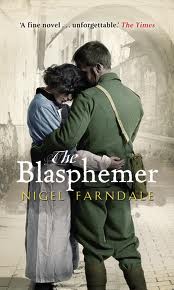
THE BLASPHEMER by Nigel Farndale

My goodness, there is SO much going on in this book, it's a minor miracle it is all packaged up and concluded in 492 pages. Is there a God or is there not? Was the earth created in seven days or not? Are there angels or not? And that is just for starters. But having said that, these three questions form the crux of the novel.

Daniel Kennedy is an atheist. He is also an associate professor of zoology at Trinity College in London, and has recently written and fronted a natural history television programme.  He lives in London with his long time girlfriend Nancy and their nine year old daughter Martha. When the book opens he and Nancy are preparing to take a trip to where the creation vs evolution debate began - the Galapagos Islands. On the way to their island destination, the sea plane crashes, Daniel makes an error of judgement, but does survive, as does Nancy, although his actions reverberate for months afterwards. Immediately post crash, as penance perhaps, Daniel makes the decision to swim the 14-odd kilometers to shore for help and during the swim has a vision of a young man - angel - who encourages him, enabling Daniel to hang on and eventually reach shore. All is well. Except for Nancy and Daniel's relationship which goes into freefall.

Running parallel to Daniel's story is that of his great grandfather, Private Andrew Kennedy, 21 years old, on his first day facing the horrors of Passchendaele. Andrew is a plumber, a very ordinary young man, brought up to believe in a God and that God is on the side of the right, which naturally includes him. His first day of war is a complete disaster, and he sees a vision which takes him off the battlefield, into a village in France, only to find himself some months later in front of a firing squad for desertion.

As if these two threads don't have plenty of potential for plot and character, the author also throws in radical Muslims and terrorist attacks,  a bitter and twisted university academic, nine year old Martha madly in love with her teacher, Mahler and Vaughan Williams, old age and mortality, distinguished military careers, other love interests, and long winded philosophical discussions on whether there are angels or are such visions a frontal lobe malfunction due to extreme stress. Quite frankly it all gets a bit much, with the whole story becoming quite incongruous and far too many coincidences for it to have any chance of being truly credible.

But despite the weakness with plot and lack of character development of some important people in the story, this does actually read very well and is quite a page turner. The author knows how to make a story. I did enjoy it, and who knows, maybe there really are angels out there.